

Most B2B organisations think they have a lead quality problem. In reality, they have a handoff problem.
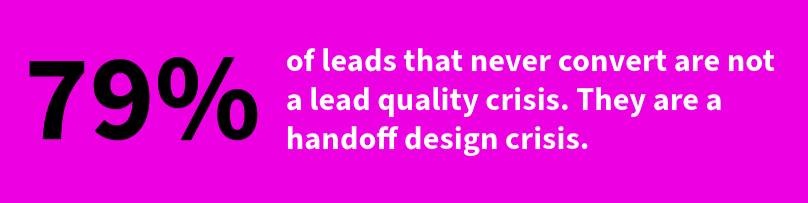
MarketingSherpa found that 79% of marketing-generated leads never convert into sales. The usual response is to retune the funnel: better targeting, sharper scoring, more nurturing. Our experience inside B2B revenue engines points to a different answer.
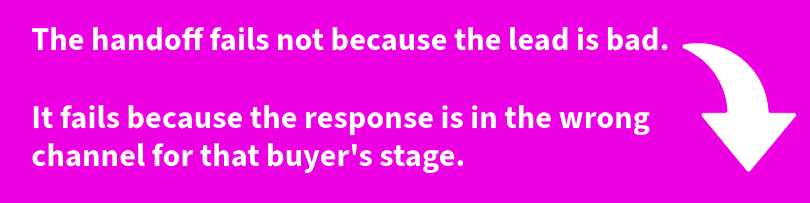
The real failure point is the handoff.
It is the operational gap between a buyer raising their hand and a sales conversation that actually progresses. At GKJ Consulting, we call this the Conversion Gap. It is where revenue quietly dies. It is also where the highest leverage in your commercial model now sits.
Why the handoff matters more than it used to
The B2B buying journey has shifted under our feet.
Gartner finds that buyers now spend only 17% of their total purchase time meeting with potential suppliers. When evaluating multiple vendors, the share of attention any single supplier receives can fall to just 5% or 6%
The remaining 80% plus is spent on independent research, peer conversations, and internal consensus building.
That changes the meaning of an inbound lead.
The moment a buyer puts their hand up is no longer the start of a relationship. In most cases, it is the only window you will get. If your handoff is slow, generic, or in the wrong channel, that window closes. The buyer does not tell you they have left. They simply do not come back.
The four failure points inside the Conversion Gap
In every B2B handoff diagnostic we run at GKJ, four root causes appear with predictable regularity.
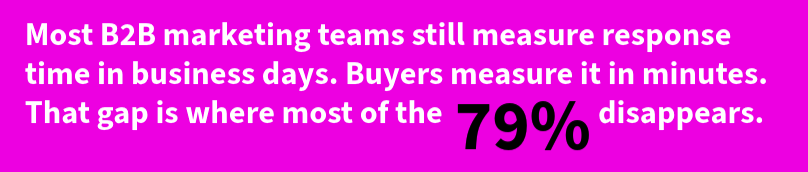
1. Speed: You are too slow by an order of magnitude
The most quoted study in lead management still holds up.
In “The Short Life of Online Sales Leads”, published in Harvard Business Review by James Oldroyd, Kristina McElheran, and David Elkington, the authors found:
- Companies contacting a lead within one hour were nearly seven times more likely to have a meaningful conversation than those who waited even sixty minutes longer
- The drop off between five minutes and thirty minutes is steeper still
- After twenty-four hours, qualification odds collapse
2. Channel: You are not where the buyer actually is
McKinsey describes the modern B2B journey as the rule of thirds.
Roughly a third of the buying journey now happens in person, a third in remote human interaction, and a third in fully digital self-service. Buyers expect to move seamlessly between all three.
Most handoff processes pretend that only one channel exists:
- A web form triggers an SDR phone call, even when the buyer has spent six weeks consuming digital content and would rather book a demo themselves
- A live event lead is dropped into a generic automated email sequence
- A high-intent self-service signal is ignored because no human owns it
3. Alignment: your teams think they agree, and they do not
This is one of the more uncomfortable findings of recent years.
Forrester reports that 82 percent of C-level executives believe their sales and marketing teams are aligned. Yet 65 percent of the frontline sales and marketing professionals doing the work say they are not.
That perception gap shows up at the handoff in three places:
- Different definitions of qualification. Marketing’s MQL is not sales’ SQL
- Unenforced response SLAs. Agreements exist on paper, not in practice
- Broken feedback loops. Sales rarely tells marketing what is and is not converting
None of these are visible on a dashboard. All of them are visible in the conversion rate.
4. Buying group: You are talking to one person when the decision needs ten
Gartner’s research on B2B buying groups is essential reading for any marketing leader.
The average complex purchase now involves between 6 and 10 stakeholders. Each one gathers four to five pieces of independent information before bringing it back to the group.
Your lead is one person inside a committee you cannot see.
If your handoff treats those leads as the sole decision maker, you will lose. Modern handoff design has to enable the lead to sell internally, not just sell them on you.
What good looks like: an illustrative example
To make this concrete, consider a typical scenario we see in B2B SaaS organisations with strong lead volume but weak pipeline conversion. The diagnosis usually surfaces the same culprit. Average inbound response time sits well over twenty-four hours.
A redesigned handoff layer in this scenario would centre on four interventions:
- Routing logic to put the right rep on the right lead the first time
- Calendar booking embedded at the point of intent
- Tiered response SLAs by lead score and channel
- A jointly owned, written definition of qualified between sales and marketing
The kind of shift this typically delivers within a quarter:
- Response time compressed from a working day to under thirty minutes
- A meaningful uplift in qualified meeting conversion on the same lead volume, often in the range of 30 to 50 percent
The lead source has not improved. The handoff has.
The principle is well documented in the underlying research cited above. The numbers will vary by sector, deal size, and channel mix, but the direction of travel is consistent.
The GKJ Conversion Gap Diagnostic
When we audit a handoff layer, we look at four things, in this order:
- Definition. Is qualified agreed between sales and marketing, in writing
- Speed. How long between buyer signal and human response
- Channel. Does the response match how the buyer wants to engage
- Enablement. Can the lead carry the case back to their buying group
Each is fixable on its own. Fixed in sequence, they compound.
The bigger shift
Marketing’s job in 2026 is no longer to generate leads and hand them to sales. It is to design the entire commercial experience around how buyers actually decide. The handoff is the highest stakes moment in that design.
Most B2B organisations are still optimising the wrong end of the funnel. The ones that win the next five years will treat the handoff not as a process, but as a product.
Working with GKJ Consulting
If your B2B organisation is generating demand but struggling to convert it into a pipeline efficiently, the Conversion Gap is almost certainly part of the cause. Contact us for a no-obligation chat about your issue.