

Email remains one of the highest ROI marketing channels in 2026, but the gap between an average programme and a top-performing one has widened sharply. Deliverability rules changed in 2024. Apple’s privacy protections broke older metrics. Lifecycle email automation now outperforms broadcast campaigns by a wide margin in both B2C and B2B email marketing.
This guide is the working playbook GKJ Consulting uses with small business clients. It covers what is actually working now, what has stopped working, and the practical standards a modern email programme needs to meet. Every claim links to a primary source.
Email still pays, but the spread between programmes is huge
Litmus’ 2025 State of Email report found marketers report email marketing ROI between 10 to 1 and 36 to 1, with the top 8 percent of programmes hitting 45 to 1 or higher. The interesting detail is what those top performers actually send. They do not lead with promotional blasts. They lead with newsletters and onboarding sequences.
The lesson is simple. Promotional emails are a tax on subscriber attention. Value-first content earns the right to be promoted.
The first question we ask any new client is “What would your list miss if you stopped sending tomorrow?” If the truthful answer is “nothing”, that is the problem to fix before any tactical work begins.
Get consent right, or none of the rest matters
UK email marketing is governed by the Privacy and Electronic Communications Regulations (PECR), which sit alongside UK GDPR. The ICO’s guidance on direct marketing using electronic mail is the source of truth. Consent must be specific, knowingly given, and recorded through a clear positive action. Pre-ticked boxes do not count.
There is one exception that small businesses underuse, the soft opt-in. If someone bought from you (or negotiated to buy), you can email them about similar products or services as long as you offered them a chance to opt out at the point of capture and in every message after.
The Data (Use and Access) Act 2025 received Royal Assent on 19 June 2025 and introduced amendments affecting parts of UK GDPR and PECR, with implementation staged over time. This is not legal advice, but if your last consent and privacy notice review predates June 2025, it is worth a fresh look.
Authenticate, or your email will not arrive
Email deliverability is the single biggest change in the last two years, and most small business owners have no idea their email infrastructure is exposing them.
Since February 2024, Google and Yahoo have required all bulk senders (more than 5,000 messages a day to their users) to authenticate with SPF, DKIM, and DMARC, keep user-reported spam rates well below 0.3 percent in Google Postmaster Tools, and offer one-click list unsubscribe in line with RFC 8058.
Two practical points. First, the 5,000 a day threshold is per mailbox provider. A small business that sends a 25,000-person newsletter to a mostly Gmail list once a week is in scope. Second, unauthenticated mail is rarely bounced loudly. It quietly slips into spam. Most senders never know.
If you are not sure whether your domain is properly authenticated, the test takes under a minute with any DMARC lookup tool. Misconfigured SPF, DKIM, or DMARC records can interrupt legitimate sending, so changes should be staged and monitored before being enforced.
Stop measuring opens like it is 2019
Apple introduced Mail Privacy Protection in iOS 15 in 2021. It pre-fetches images for Apple Mail users, which fires the tracking pixel even when the email is never opened. Apple Mail has held a 49 to 58 percent share of email opens through 2025, so on most lists, open rate is now a noisy, inflated, and unreliable metric for absolute performance.
Use it for trend lines, not benchmarks. The metrics that survived MPP are clicks, replies, conversions, and revenue per send. If your team is still optimising subject lines purely against open rate, you are optimising against a ghost.
Treat email as a lifecycle programme, not a campaign schedule
Most small business email plans are a wall calendar of sends. That is a campaign approach. Lifecycle email marketing is built around the subscriber’s relationship with your business, not your content calendar.
The difference looks like this in practice.
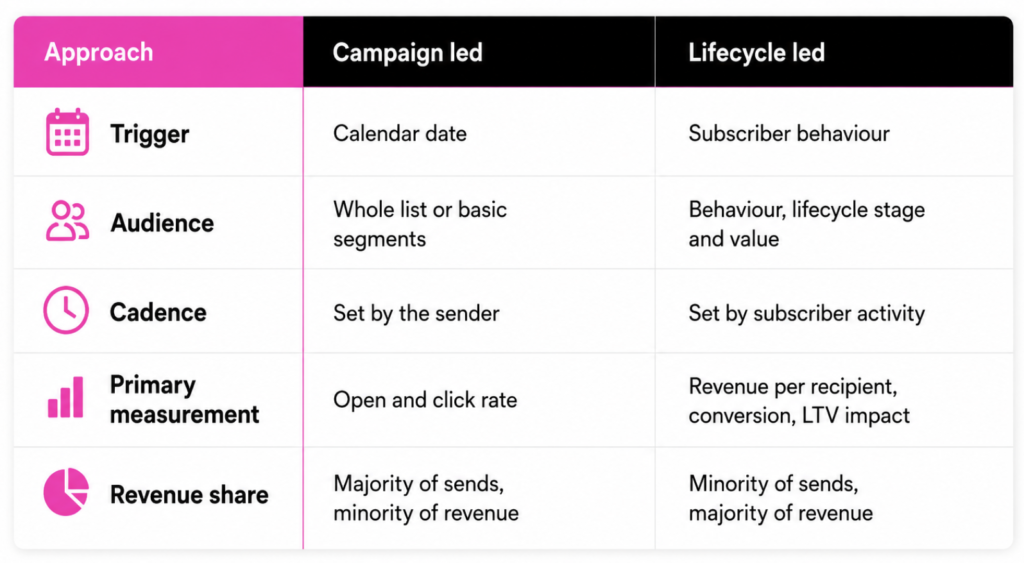
The revenue share point is not opinion. Klaviyo’s 2025 benchmark report shows automated flows generate around 41 percent of total email revenue from only 5.3 percent of sends, with revenue per recipient around 18 times higher than broadcast campaigns.
The five email automation workflows worth building, roughly in order of impact for most B2C and B2B businesses, are a welcome email sequence, an onboarding sequence, a lead nurture series, a post purchase sequence, and a win back sequence.
A welcome series sets expectations and earns the first click. It is typically the highest performing automated email in the mix.
An onboarding sequence supports any product or service that requires the customer to do something to get value. Litmus’ top performer data names onboarding as a core driver of the highest ROI programmes.
A lead nurture series for prospects not yet ready to buy, mapped to the awareness, consideration and decision stages of the buyer journey.
A post purchase sequence to ask for the review, prompt the cross sell, and prime the second purchase.
A win back sequence for lapsed subscribers, run on a clear cadence with a clear exit, so disengaged contacts are pruned rather than dragged. A list that is not pruned erodes deliverability for everyone else on it.
Segment beyond the first name
Email segmentation in 2026 means relevance, not the merge tag.
The framework we use at GKJ has three layers. Behavioural (what they have and have not done), lifecycle stage (new, engaged, lapsing, lapsed) and value (revenue or fit). The lift is in the combination. A “lapsing high value” segment responds to a different message than a “new low value” one, and treating them the same is the most common reason small business email marketing underperforms.
A useful test. If you sent the same email to your top decile and your bottom decile last week, you have a segmentation problem to fix this week.
Design for mobile, write for skimming
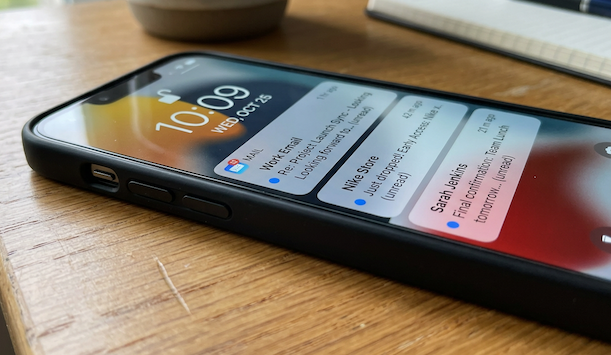
Mobile is now the dominant context for email opens, with mobile clients accounting for the largest share tracked in Litmus email client market share data.
That means single column layouts, tap target friendly calls to action, body copy that works without images loading, and a subject line plus preview text combination that earns the tap on its own merits.
Plain text style emails often outperform heavily designed HTML for the same audience, particularly in B2B email marketing. We test this on most new programmes and the simpler version wins more often than people expect.
Test what matters, not what is easy
Subject line A/B tests are the most run experiment in email and one of the least useful in 2026. They give a noisy signal on a degraded metric (see Apple MPP above).
The tests that actually move revenue are offer tests rather than creative tests (ten percent off versus free delivery reveals real demand structure), send time tests on the same audience and offer, from name tests (especially “person at company” versus “company”), frequency tests by segment, and holdout tests for any always on flow. If you cannot prove your welcome series outperforms no welcome series at all, you do not really know what it is worth.
Compliance is a feature, not a tax
A clean unsubscribe, a visible postal address, a clear sender identity and a recorded basis for consent are not just PECR and UK GDPR requirements, they are signals of a sender people trust.
Mailbox providers measure trust through engagement rates, complaint rates and spam folder placement. Compliance, deliverability and revenue are the same conversation, not three separate ones.
What good looks like in the wild
A few of the patterns we see most often when auditing small business email programmes, illustrative rather than promised:
A correctly aligned DMARC record combined with active spam complaint monitoring will usually lift inbox placement by a measurable margin within the first reporting window after the fix. The Google sender guidelines linked above explain why.
A well built welcome sequence frequently produces the highest revenue per recipient of any email a small business sends, often by a factor of several, in line with the Klaviyo benchmark data.
Moving from broadcast to a layered segmentation model (behaviour, lifecycle, value) typically reduces total send volume while increasing total revenue, because relevance lifts conversion faster than reach does.
If you can run an audit against these three patterns honestly and answer “all good”, you have a top quartile programme. Most do not.
A short audit you can run this week
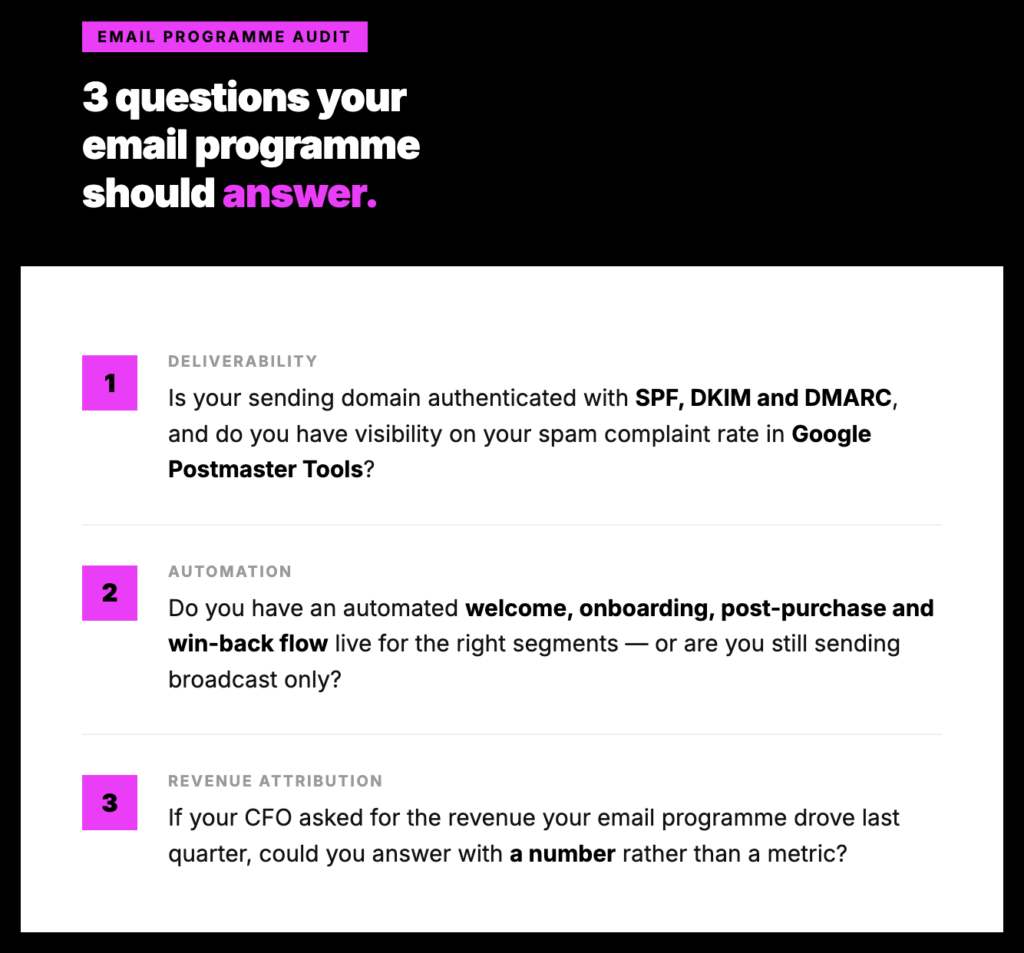
If the answer to any of those is “not really”, the programme has a clear next step.
Where GKJ Consulting fits in
We are a new agency staffed by seasoned marketers, set up to give small businesses large agency depth at small agency pricing. We work as a full service marketing function, covering content and copywriting, funnel design, landing pages, lifecycle email and the measurement that ties it back to revenue.
A typical engagement starts with a short audit of the existing programme against the principles above (consent, authentication, lifecycle coverage, segmentation, measurement) and a clear shortlist of fixes. From there we build the funnel, write the content, design the landing pages and run the email programme as a lifecycle, not a calendar.
Most audits we run surface at least one significant deliverability, automation or segmentation gap inside the first 30 minutes. If your programme has not been reviewed in the last 18 months, that gap is almost certainly costing you revenue every send.