


Traditional SEO audits are produced by humans working through a checklist. They catch the obvious issues and miss the patterns hiding in thousands of data points that no consultant has the time to correlate manually. AI audits work differently, and at GKJ, that difference is the foundation of everything we do in SEO.
When a business tells us their SEO has plateaued, the first question we ask is: How was your last audit conducted? The answer is almost always a version of the same thing. A consultant, or an in-house team member, ran a crawl tool, looked through the output, wrote up the biggest issues they recognised, and produced a report. That report then sat in a folder while the team debated priorities.
That process isn’t wrong. It’s just limited. A human auditor, however skilled, is constrained by time, by the number of data sources they can hold in their head simultaneously, and by the patterns they’ve been trained to look for. SEO performance is increasingly determined by factors that don’t show up clearly in any single tool, and by relationships between signals that take more processing power than any consultant has available in a working day.
This is precisely what AI changes. And it’s why at GKJ, our SEO audits are built on proprietary AI software rather than manual review. Not as a marketing claim, but as a fundamental difference in what we can see, and therefore what we can fix.
What AI actually does in an SEO Audit (that humans can’t)
It’s worth being specific here, because ‘AI-powered’ has become a phrase that gets attached to almost everything. What does it actually mean in the context of an SEO audit?
Processing scale: thousands of signals at once
A typical website of any meaningful size has hundreds of pages, each with dozens of technical and content signals: crawlability, indexation status, page speed across devices, Core Web Vitals, internal link equity, keyword targeting, content depth, structured data, canonical tags, user engagement data, and more. Multiply that by hundreds of pages, and you’re looking at tens of thousands of individual data points.
A human auditor samples this. They look at the most important pages, check the most common issues, and extrapolate. An AI processes all of it, simultaneously, without sampling bias. Every page. Every signal. Every relationship between them. The coverage alone changes what’s possible.
Pattern recognition across data sources
The most valuable SEO insights don’t live in any single tool. They emerge from the intersection of multiple data sources: how crawl data correlates with ranking performance, how user engagement metrics relate to content depth, and how internal link architecture affects authority distribution across topic clusters. These correlations exist in the data, but connecting them manually across Google Search Console, GA4, crawl data, and content metrics is prohibitively slow.
Our AI pulls from all of these sources simultaneously and identifies the patterns that explain performance gaps. Not just ‘this page has a slow load time’ but ‘these 14 pages in your highest-value topic cluster have a combination of crawl inefficiency and thin content that is collectively suppressing rankings for your most commercially important keywords.’ That level of diagnosis is what leads to meaningful action.
Dual-perspective analysis: search engines and real users
Our proprietary software analyses your website from two perspectives at the same time: how search engine crawlers interpret and index it, and how real users experience it. This dual lens matters because the two perspectives diverge more than most people expect.
A page can be technically accessible to crawlers and still perform poorly because user engagement signals, dwell time, scroll depth, and interaction rate tell Google it’s not satisfying search intent. Conversely, a page users love can be invisible in search because of a single technical barrier. Seeing both simultaneously is what allows us to diagnose root causes rather than surface symptoms.
Impact-weighted prioritisation
Perhaps the most practically important thing AI does in an audit is rank the findings by likely commercial impact. Traditional audits produce lists, sometimes hundreds of items long, with little guidance on where to start. Teams default to fixing what’s easy, not what matters most.
Our AI weighs every finding against the commercial value of the pages affected, the volume of search demand involved, and the likely uplift from fixing the issue. The roadmap we produce isn’t a ranked list of SEO issues. It’s a ranked list of business opportunities, ordered by the return your team will get from acting on them.
What the AI Audit uncovers across three dimensions
The audit examines your website across three interconnected areas. Each is analysed in isolation and in relation to the others, because fixing one area in the absence of the others rarely moves the needle as much as a coordinated approach.
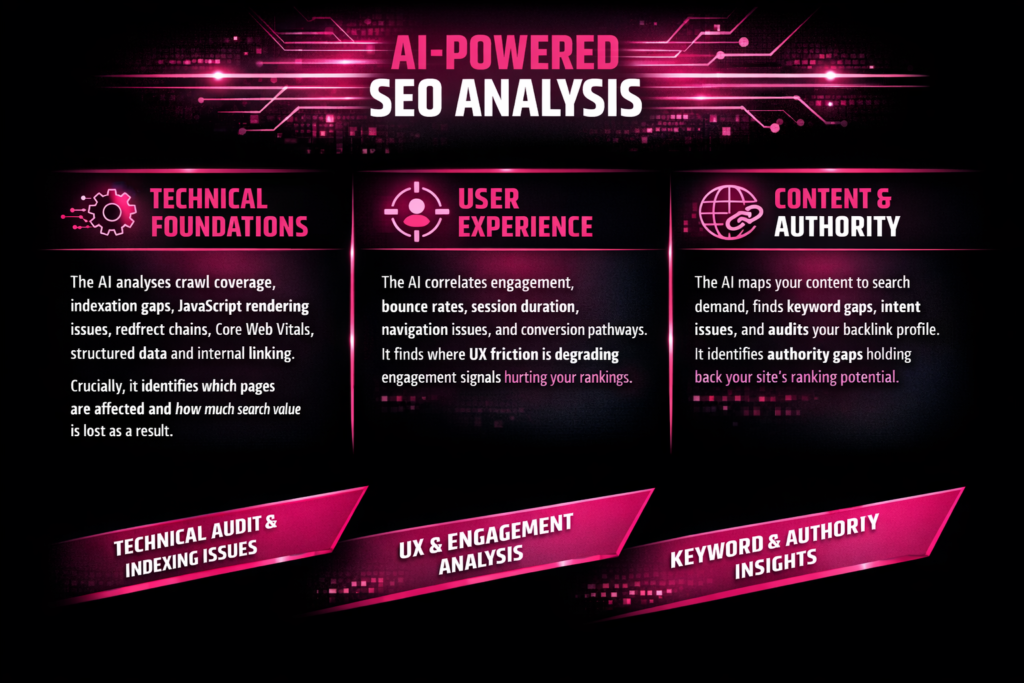
The insight that emerges from combining all three dimensions is what makes this approach genuinely different. A content gap in a high-priority topic means less if there’s a crawl barrier preventing those pages from being indexed. A technically clean page with strong backlinks may underperform because UX signals tell Google users aren’t finding what they came for. The AI surfaces these compound issues, and that’s where the biggest performance gains usually live.
What you receive: A roadmap, not a report
The output of an AI-powered SEO audit is deliberately designed to be usable, not impressive. The goal isn’t to demonstrate how much data we can process. It’s to give your team a clear, prioritised plan for what to do next.
For leadership: strategic clarity
Marketing Directors and Heads of Marketing receive a clear narrative: where SEO performance is being held back, what the highest-value opportunities are, and what a realistic performance trajectory looks like if the roadmap is executed. No jargon, no data dumps. A business case for where to invest time and budget, supported by evidence.
This matters because SEO budgets are perpetually under pressure to justify themselves. When you can show leadership a specific causal chain, fixing these technical issues on these pages will improve rankings for these keywords, which historically generate this volume of qualified leads, and the conversation changes.
For technical teams: implementation-ready specifics
Developers and SEO managers receive findings at the level of specificity they need to act without ambiguity. Not ‘improve page speed’ but a precise list of the pages failing Core Web Vitals thresholds, the specific elements causing the failures, and the recommended fixes in priority order. Not ‘address crawl issues’ but the exact pages with noindex directives that shouldn’t be there, the redirect chains that need consolidating, and the crawl budget inefficiencies costing you index coverage.
The difference between a vague brief and a specific one is the difference between weeks of back-and-forth and a development sprint with clear outcomes. The audit is designed to eliminate the former.
Beyond traditional SEO: AEO, GEO, and future-proofing
Search is changing faster than at any point in the last decade. Google’s AI Overviews, Perplexity, ChatGPT Search, and other AI-native discovery tools are reshaping how users find information and which sources they find it from. Answer Engine Optimisation (AEO) and Generative Engine Optimisation (GEO) are no longer future concerns. They’re present ones.
The good news is that the foundations of strong traditional SEO and strong AEO/GEO overlap substantially. Sites with clear technical health, genuine content depth, unambiguous topical authority, and strong E-E-A-T signals (Experience, Expertise, Authoritativeness, Trustworthiness) tend to perform well across all of these surfaces. Getting the fundamentals right now is simultaneously the best traditional SEO strategy and the best preparation for how search will work in 18 months.
Our AI audit includes an assessment of your AEO and GEO readiness, specifically, how well your content is structured to be cited and surfaced by AI-generated answers, and where gaps in topical coverage or content format are reducing your chances of appearing in these increasingly prominent placements.

The bottom line
Traditional SEO audits are limited by the speed and scope of human analysis. They find what’s obvious, miss what’s complex, and produce reports that are difficult to prioritise and act on.
AI-powered audits process every signal across your entire site simultaneously, identify the compound issues that are really driving underperformance, and deliver findings ranked by the commercial impact of fixing them. That’s not a marginal improvement on the traditional approach. It’s a fundamentally different level of visibility.
If your SEO feels like it’s running on incremental improvements that never quite break through to a new level of performance, the audit is where the answer usually lives. And with AI doing the analysis, the answer is clearer and faster to find than it’s ever been.
Ready to see your website the way AI sees it?
Our AI-powered SEO audit analyses your site across thousands of technical, experiential, and content signals simultaneously, then delivers a prioritised roadmap ranked by commercial impact. No guesswork. No generic checklists. Just a data-led plan for measurable growth.