

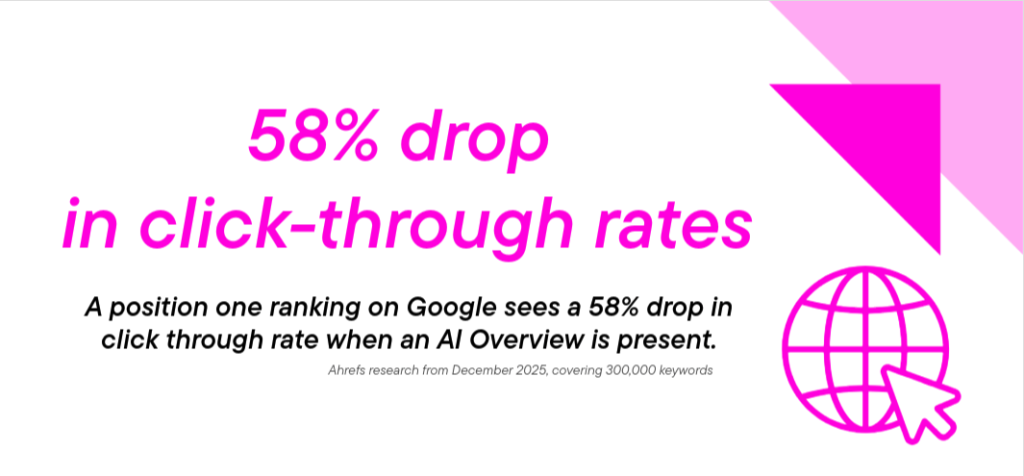
The rules of search have changed. Not gradually. Fundamentally. If you are still measuring marketing performance purely through Google rankings and organic click rates, you are already behind a shift that is reshaping how buyers find businesses, compare solutions, and make decisions.
AEO (Answer Engine Optimisation) and GEO (Generative Engine Optimisation) are not buzzwords invented by agencies to sell new retainers. They are a genuine response to a structural change in how search works, and understanding them is now a business priority, not a technical one.
Defining AEO
Answer Engine Optimisation is the process of creating and formatting content so that AI answer engines can easily understand and surface it when answering user questions. Unlike traditional search engines that offer a list of links, answer engines deliver a specific answer, often as a snippet, a knowledge panel, or a voice response. Conductor
The practical focus of AEO is structured clarity. A page can rank well in traditional search and still never appear in an AI response. The reverse is also true: a page can earn AI citations even when it does not drive a visit. AirOps This means the optimisation game now has two separate surfaces that need to be addressed independently.
Defining GEO
Generative Engine Optimisation is the practice of optimising content to appear as sources and citations in AI-generated responses from platforms including ChatGPT, Perplexity, Google AI Overviews, and others. Frase
Where traditional SEO targets link-based search rankings, AEO and GEO target the retrieval-augmented generation pipelines that power modern AI answers. AEO values factual density over keyword density, structured answer blocks over page-level relevance, and content freshness over historical domain signals. GenOptima
GEO is the broader strategic frame. AEO is the specific execution layer focused on being selected as the cited source. Both require the same foundational shift in how content is written, structured, and maintained.
Why This Matters Commercially
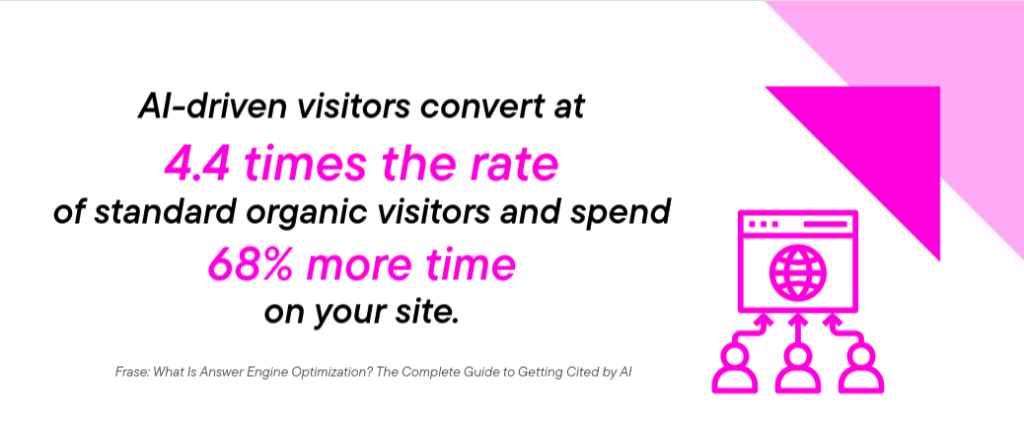
AI-driven visitors convert at 4.4 times the rate of standard organic visitors and spend 68% more time on site. Users who arrive via AI citations tend to be further along in their research process, making them higher-intent prospects. Frase
This is the commercial argument that should matter most to a Marketing Director. It is not about chasing a new platform. It is about being present at the moment when a buyer is actively seeking an answer to a problem your business solves, and being the source an AI engine trusts enough to quote.
70% of organisations believe AEO will significantly impact their digital strategy within one to three years, but only 20% have begun implementing it. Frase That is the opportunity window. Early movers build citation authority while competition is low.
What Good Implementation Looks Like
The fundamentals are not complicated, but they require discipline. Structure content with direct answers in the first 40 to 60 words, maintain a high fact density with statistics cited every 150 to 200 words, reference authoritative sources throughout, and implement proper schema markup. Frase
Content that lacks expert review tends to get dropped from AI citations once better-sourced alternatives appear. AirOps The AI content glut is real. Platforms publishing AI-generated copy without editorial oversight are building on sand. Substance and verifiable authority are what earn and hold citation positions.
According to Search Engine Land research from 2025, pages not updated quarterly lose AI citations at three times the normal rate. Freshness signals matter as much as structure.
AEO and GEO are not a replacement for SEO. SEO provides the technical foundation, including site speed, authority, and mobile performance, while AEO optimises content for AI synthesis. Both are required to maintain full search visibility in 2026.
The Strategic Takeaway
Buyers are getting answers from AI before they ever reach your website. The question for every Marketing Director is whether your brand is the one being cited, or whether a competitor is occupying that space by default.
This is not a future consideration. It is happening now. The organisations building structured, authoritative, citation-ready content today are the ones that will own an AI-referred pipeline tomorrow. Those waiting for certainty before acting will find the gap increasingly difficult to close.
GKJ Consulting works with marketing teams to build a content strategy that performs across both traditional and AI-driven search. If your current approach was designed for a world that no longer fully exists, it is worth a conversation.