

You are not imagining it. The brief from the board says deliver more pipeline, better attribution, stronger brand awareness, and measurable ROI. The budget is the same as last year. Welcome to the defining tension of B2B marketing right now.
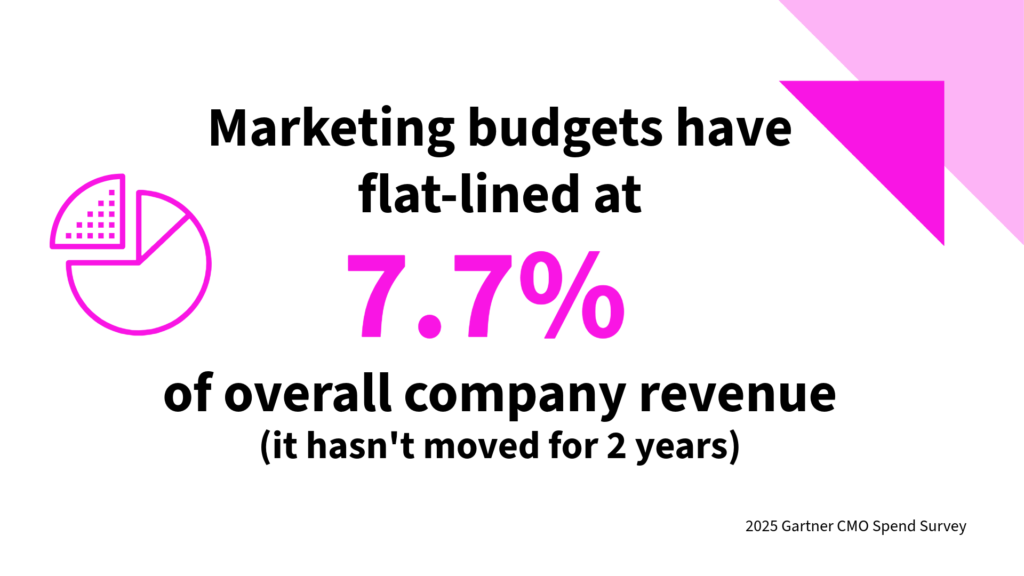
The 2025 Gartner CMO Spend Survey confirmed that marketing budgets have flatlined at 7.7% of overall company revenue and that figure has not moved in two consecutive years. Half of all CMOs surveyed are actually working with budgets of 6% or less, well below what most would consider sufficient to execute a competitive strategy. Meanwhile, paid media now accounts for 30.6% of marketing budgets, and media price inflation means CMOs are getting less for every pound spent.
So the money is the same. The inventory is more expensive. The expectations have not received that memo.
This is not a complaint. It is a strategic reality that the best Marketing Directors are already working around, and the ones who are not are going to find budget conversations in 2026 considerably harder.
The real problem is not the number; it is the allocation
Most teams facing flat budgets default to one of two responses. They either spread spending thinly across everything to maintain the appearance of coverage, or they cut what feels least defensible, which usually means brand. Both are wrong.
The Gartner data shows that CMOs facing budget constraints are cutting allocations to talent, technology and agencies while pushing an ever-larger share into paid media channels. This is understandable. Paid media is measurable and fast. But it is also where costs are rising fastest, and where results become increasingly dependent on creative quality rather than spend volume.
The reflex to pour flat budgets into paid channels because they are trackable is one of the most expensive habits in B2B marketing. You end up spending more to buy the same reach, while the channels that build long-term demand, including content, organic search, earned media, and retention, are quietly starved.
The Gartner survey also found that brand awareness accounts for only 29% of media spend, and fewer CMOs are prioritising brand investment in 2025 versus performance channels, despite evidence that cutting brand spend does not yield immediate gains. It just defers the cost. When the brand gets quieter, the performance channels have to work harder, and CPCs climb.
The three questions your budget allocation should answer
Before you decide where money goes, get honest answers to these:
Where is spend producing results that compound? Paid campaigns produce results while the money is flowing. SEO, content, email, and retention programmes produce results that accumulate. A flat budget is an argument for shifting your mix toward compounding channels, not away from them.
Where are you paying for reach you have already bought? Most B2B teams are running duplicated or overlapping campaigns across channels targeting the same audience. The top productivity actions taken by CMOs in 2025 include leveraging data and analytics to optimise performance and harnessing AI to automate key tasks. Before you cut headcount or reduce agency scope, audit whether your existing spend is structured efficiently. In our experience working with marketing teams, consolidating fragmented campaign activity alone typically recovers 15 to 20% of the effective budget.
Where is the measurement broken? According to EMARKETER and StackAdapt research, over three-quarters of B2B marketers use past performance to determine budget allocation. That sounds rational. The problem is that past performance data is often incomplete, particularly for upper-funnel activity. If you are allocating on past data and the attribution is flawed, you are compounding bad decisions, not optimising good ones.
What actually moves the needle
Flat budgets reward ruthlessness, not activity. The Marketing Directors who are making flat budgets work in 2025 are doing three things differently.
They are treating measurement as a strategic function, not a reporting exercise. They know which channels are genuinely influencing pipeline and which ones look good in dashboards but do not close deals. They have built the business case for this internally, and the board trusts the numbers.
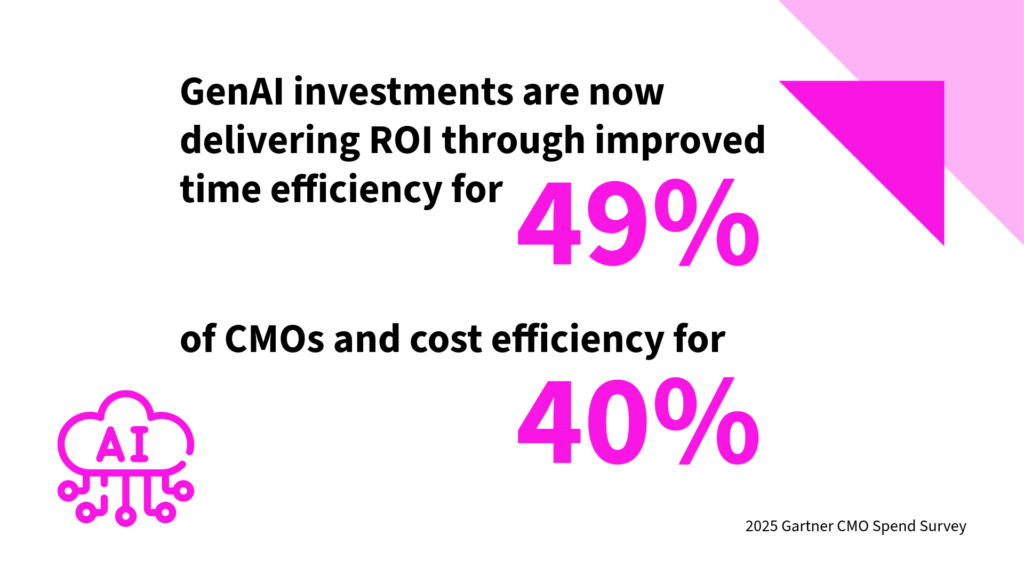
They are investing in retention alongside acquisition. GenAI investments are now delivering ROI through improved time efficiency for 49% of CMOs and cost efficiency for 40%. The teams extracting real value from AI are not just using it to produce more content. They are using it to personalise retention programmes and automate the mid-funnel activity that was previously too resource-intensive to run properly.
And they are simplifying. Fewer campaigns, more tightly targeted. Fewer channels, each executed with genuine quality. Less activity that creates the impression of momentum, more work that builds an actual pipeline.
The expectation gap will not close by asking for more budget. It closes when you demonstrate that you are extracting full value from what you already have. That case, made clearly, is usually the fastest route to getting more.
If you want an objective view of where your current budget is working and where it is being absorbed without return, that is precisely what GKJ Consulting exists to do. Talk to our team.