

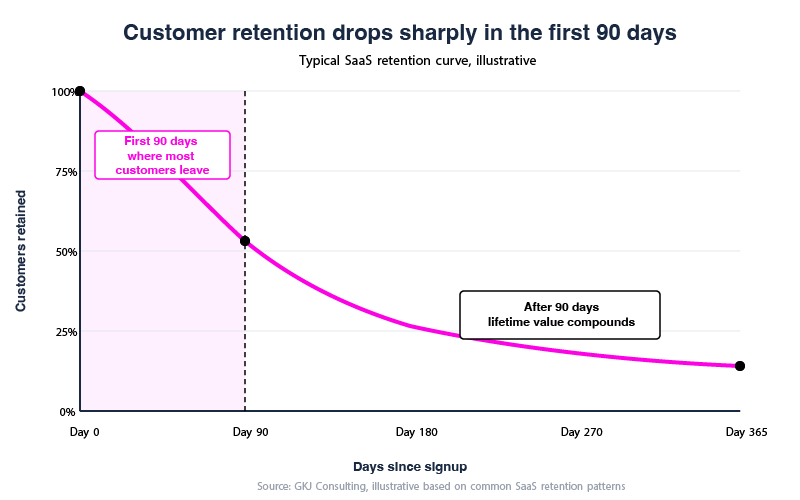
Most SaaS and subscription businesses lose more customers in the first 90 days than at any other point in the lifecycle. Get those three months wrong and your CAC payback becomes a leaky bucket. Get them right and you compound revenue for years.
Here is what the data actually says, and what works in practice.
Why 90 days matters
Frederick Reichheld’s research at Bain & Company found that a 5 percent increase in customer retention can lift profits by 25 to 95 percent, depending on the industry. That figure has held up across decades of follow-up studies because it captures something simple: the longer someone stays, the more they spend, the cheaper they are to serve, and the more likely they are to refer someone else.
The first 90 days are where this fight is won or lost. Wyzowl’s onboarding research, surveying hundreds of consumers, found that 86 percent of people say they are more likely to stay loyal to a business that invests in welcoming and educating them after purchase. The same study found that around 8 in 10 users have deleted an app because they did not know how to use it.
That is the brief. Show people the value, fast, or they leave.
The “aha moment” is not a marketing phrase
Every product has a moment where a new user finally understands why they signed up. Slack publicly attributed theirs to roughly 2,000 messages exchanged inside a team. Facebook’s growth team landed on 7 friends added in 10 days. Dropbox found it was placing one file in one folder, on one device.
Your job in onboarding is not to show every feature. It is to pull the user toward that single moment of value as quickly as possible, and then stop talking.
Most onboarding fails because teams confuse education with activation. A 12-step product tour is education. A 2-step path that ends with the user achieving something real is activation. Activation reduces churn. Education does not.
What a good 90-day flow actually looks like
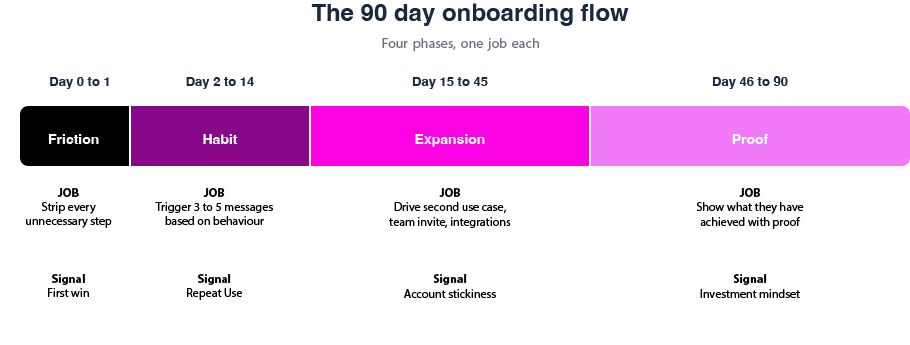
Day 0 to Day 1 is about removing friction. Cut every form field that is not load bearing. Pre-fill what you can. Send one welcome email with one clear next step, not a five-item list. Research from ProfitWell across thousands of subscription companies has consistently shown that simpler welcome flows beat complex ones on activation rate.
Day 2 to Day 14 are about habit formation. This is where most companies overcommunicate and burn goodwill. Three to five well-timed, behaviour-triggered messages outperform a daily drip every time. Trigger off what the user has and has not done, not off the calendar.
Day 15 to Day 45 are about expanding usage. Now is when you introduce the second and third use case, the integrations, and the team invite. Customers who invite a teammate inside the first 30 days churn at a fraction of the rate of solo users. This pattern holds across HubSpot, Notion, Asana, and almost every multi-seat tool that has published the numbers.
Day 46 to Day 90 is about proof. Show them what they have achieved. A simple “you sent 47 invoices and saved 12 hours this month” note converts a trial mindset into an investment mindset. People do not cancel things they feel they have built.
The mistakes we see most often
First, treating onboarding as a marketing project handed to product, or a product project handed to marketing. It is neither. It needs a single owner with authority over email, in-app messaging, support content, and the product itself.
Second, ignoring the support inbox. Your top three onboarding tickets in week one are your roadmap for next quarter. Fix them in the product or the welcome flow before you spend another pound on acquisition.
Third, measuring the wrong thing. Time on page and email open rates do not predict retention. Activation rate, time to first value, and 30-day retention do. Pick two or three and track them weekly.
A note on personalisation
Personalisation works when it changes what the user does next, not when it stitches their first name into a subject line. Segment new users by job to be done inside the first session, then route them to different activation paths. A finance lead and a marketing lead signing up to the same tool need different first wins, and a generic flow waters both of them down.
The bottom line
Reducing churn in the first 90 days is not a content problem or a UX problem in isolation. It is a focused commercial discipline that asks one question on repeat: what is the single next action that will move this user closer to value, and how do we make it almost impossible to miss?
Get that right, and retention takes care of itself. Get it wrong, and no amount of paid media at the top of the funnel will save the maths.