
The conversation around AI video in marketing has a habit of starting in the wrong place. Too many articles frame it as a question of trust: do consumers accept AI-generated content? But that is not the right question. Audiences have never cared how a visual was produced. They care whether it moves them, informs them, or makes them want to act.
Consider CGI. For decades, brands have used computer-generated imagery to create visuals that are physically impossible to film. Maybelline placed giant mascara-lashed trains on the London Underground. Jacquemus sent miniature handbags racing through the streets of Paris as toy cars, generating enormous organic reach and conversation. Nike merged real athletes with digital counterparts to visualise the future of sport. Nobody questioned the authenticity of these campaigns because the creative thinking behind them was sharp, the brand voice was consistent, and the execution was exceptional.
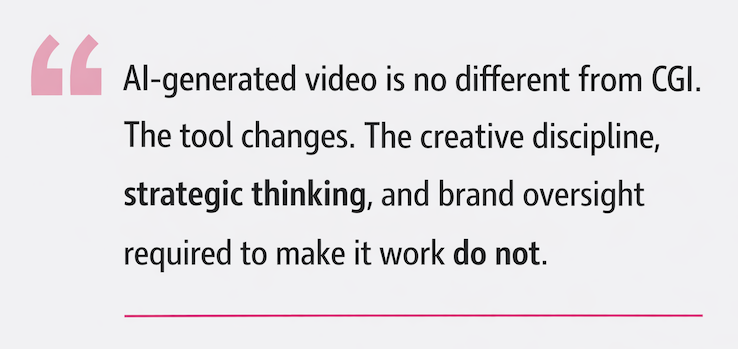
AI-generated video operates on exactly the same principle. The technology is a production tool. What determines whether it builds or undermines a brand is the quality of the strategy, the creative direction, and the human judgment applied throughout the process.
The Scale of the Shift
The adoption numbers make it clear that this is already mainstream practice, not an emerging experiment. According to Wistia’s 2025 State of Video Report, the share of marketing professionals using AI to create video grew from 18% in 2023 to 41% in 2024, with a further 19% planning to adopt it imminently. The global AI video generator market, valued at over $700 million in 2025, is projected to reach $3.4 billion by 2033. Marketing leaders who treat this as a future consideration are already behind the curve.
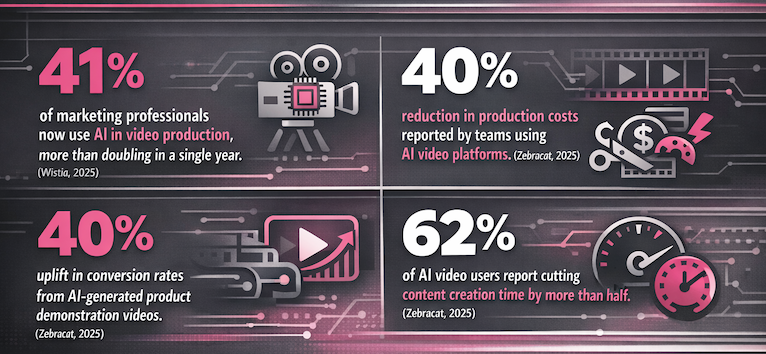
Those efficiency gains are not marginal. For marketing teams managing multiple campaigns across several markets and product lines simultaneously, compressing a six-week production timeline into days creates real competitive advantage. And when you factor in personalisation at scale, where AI enables individual-level video content that delivers a 4.5 times higher click-through rate than generic equivalents, the commercial case becomes compelling across acquisition, conversion, and retention.
Production Tool. Not Creative Director.
The distinction that matters most for Marketing Directors evaluating AI video is this: the technology produces output. It does not produce ideas. It does not understand your brand positioning, your competitive context, or your audience’s emotional relationship with your category. That understanding belongs to the people directing the work.
At GKJ, our approach to AI video production reflects this directly. https://gkjconsulting.co.uk/ai-solutions/ We deploy over 35 specialist software tools across the production process, but the workflow that governs every project draws on the same disciplines that have always defined high-quality commercial video: casting, storyboarding, and a director whose responsibility is to ensure that everything produced is a reflection of deliberate creative decision-making rather than algorithmic suggestion. The AI accelerates and scales what human talent has already shaped. It does not replace it.
This matters because the brands that have stumbled with AI video are not those who used the technology. They are those who handed the creative over to it. When the brief, the narrative, and the brand voice are all determined by a prompt rather than a strategist, the output reflects that. Audiences may not always identify the production method, but they consistently respond to whether content has been thought through or generated on autopilot.
Where AI Video Delivers the Strongest Returns
Product demonstration content is one of the highest-performing applications. Research shows AI-generated product demo videos drive a 40% uplift in conversion rates, and the ability to produce multiple variants rapidly makes them ideal for performance testing across paid channels. Explainer content, onboarding sequences, localised campaign assets, and social media variants all represent areas where AI-generated video consistently outperforms traditional production on a returns-per-pound basis.
The other major commercial opportunity is personalisation. Personalised video content delivers a 4.5 times higher unique click-through rate than non-personalised equivalents, and AI now makes this viable at a genuine scale. Whether the goal is improving retention through onboarding content tailored to individual customer segments, or driving acquisition through personalised product recommendations in video format, the economics that once made this approach impractical have fundamentally changed.
How GKJ Structures AI Video for Brand-Safe Output
The question we work through with every marketing decision-maker is not whether to use AI video, but how to build the production process so that the output meets the same standards as any other branded content. The answer lies in keeping human creative authority at the front and centre of every stage.
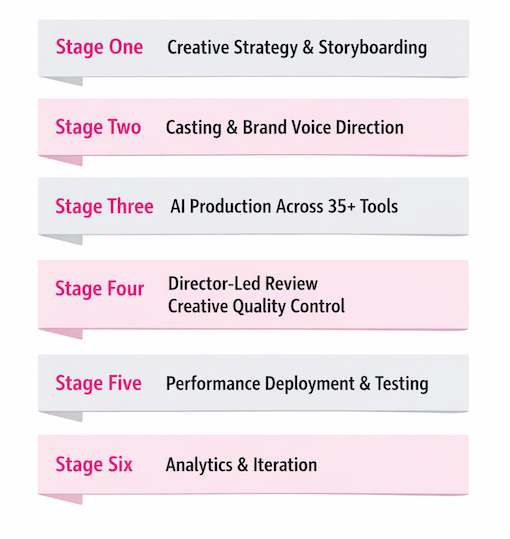
The result is video content that benefits from the speed, scale, and cost efficiency that AI production enables, without compromising the creative integrity and brand consistency that protect long-term equity. For brands that have been hesitant because of concerns about quality or brand risk, this is the approach that resolves both.
AI video is not a shortcut. In the hands of a strategist-led team with the right production infrastructure, it is one of the most powerful commercial tools available to marketing leaders today. The brands winning with it are treating it exactly as they would any other significant production capability: with rigorous creative standards, clear brand governance, and performance measurement from day one.
Ready to Explore AI Video for Your Brand?
GKJ Consulting works with Marketing Directors and Heads of Marketing to design and deliver AI video strategies that are commercially sharp, brand-safe, and built on human creative direction. If you want to understand what this looks like in practice for your product marketing, let’s start that conversation.