
Google now answers more questions before users ever reach your website. Understanding zero-click search and how to adapt your strategy around it is one of the most important challenges in modern SEO.
Picture this: a potential customer searches “how often should I review my business strategy”. Google immediately surfaces a featured snippet at the very top of the page, a neat, formatted answer pulled from someone else’s content. The user reads it, gets what they need, and moves on. No click. No visit. No lead.
This is zero-click search in action, and it is happening millions of times every day. If you’ve noticed a steady decline in organic traffic despite maintaining or even improving your rankings, this phenomenon is almost certainly part of the story.
What exactly is zero-click search?
Zero-click search refers to any search query that is satisfied directly within the search engine results page (SERP) itself, without the user needing to visit an external website. Google has invested enormously in SERP features that make this possible, and the range of those features is only growing.
The most common culprits include:
Featured Snippets (“Position Zero”): A highlighted box at the top of results that directly answers a query, pulling a paragraph, list, or table from a website, crediting but bypassing it entirely.
AI Overviews (formerly SGE) Google’s generative AI synthesises answers from multiple sources into a conversational summary that appears before organic results even begin.
Knowledge Panels & Cards: Rich information boxes for entities, businesses, people, and places that answer “who/what/where” questions instantly, without a click required.
People Also Ask (PAA) Boxes: Expandable Q&A dropdowns that keep users on the SERP, answering the very follow-up questions that would previously have driven clicks to your site.
Local Packs & Maps: For local searches, Google surfaces business listings, ratings, phone numbers, and directions, everything a user typically needs, right on the results page.
Why this matters more than ever
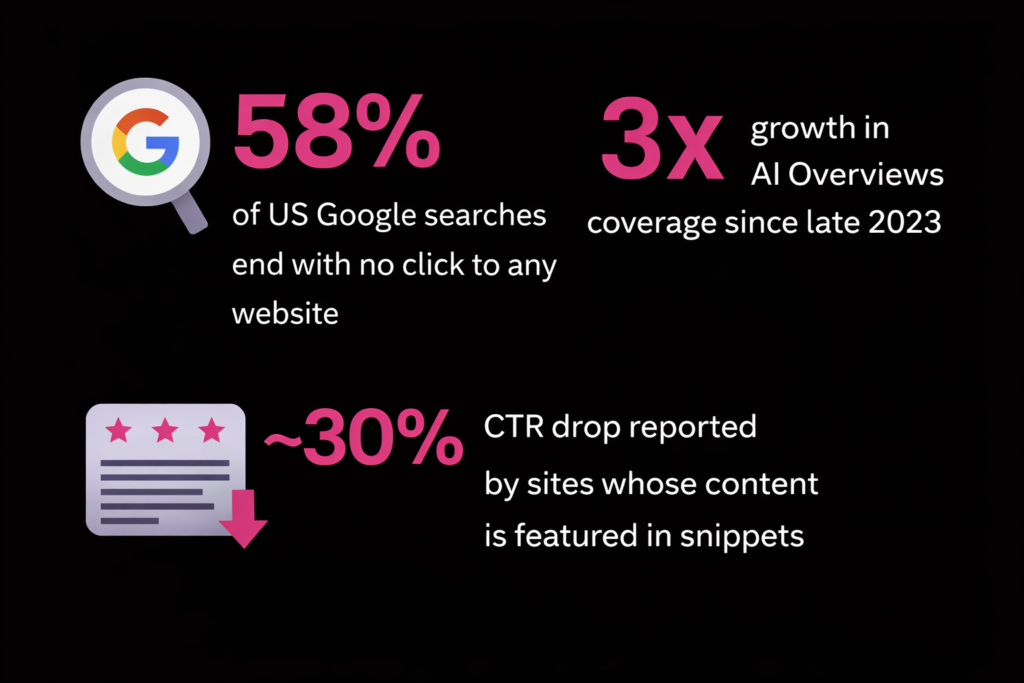
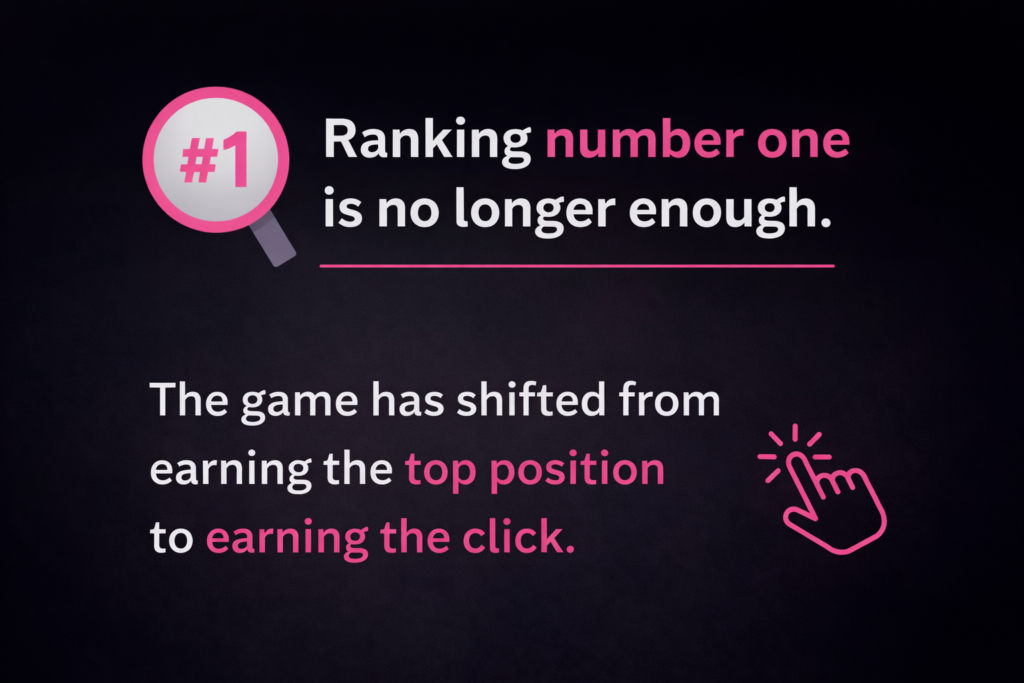
For a long time, the conventional SEO wisdom was simple: rank higher, get more traffic. That relationship is now genuinely broken for a significant slice of queries, particularly informational ones. Research consistently shows that over half of all Google searches in developed markets now result in no website visit whatsoever.
And the situation is accelerating. Google’s AI Overviews, now rolling out across the UK, represent the most significant shift in SERP behaviour in a decade. These AI-generated summaries can occupy the top third of a results page, pushing organic listings further down and dramatically reducing the visibility of even top-ranking content.
The silver lining: Zero-click does not mean zero value. Brand impressions, trust signals, and topical authority are all built through SERP visibility, even without a click. The strategic response is to optimise for both clicks and presence.
How to counteract zero-click search: 7 practical strategies
1. Target queries that demand a click
Not all search intent is equally vulnerable. Informational queries (“what is VAT?”) are the most susceptible to zero-click because they’re easy to answer in a snippet. Commercial and transactional queries (“SEO agency London” or “best CRM for small business”) are far more resistant; they require the user to actually visit a site to take action. Shift your content focus toward higher-commercial-intent keywords, particularly those in the consideration and decision stages of the buyer journey.
2. Optimise for featured snippets strategically
This feels counterintuitive, but for many queries, if you can’t beat the snippet, you should own it. Pages that appear as the featured snippet source still receive a meaningful share of clicks, often from higher-intent users. Structure your content to answer questions directly and concisely. Use clear subheadings framed as questions, provide a tight 40 – 60 word answer directly below each heading, then expand with deeper analysis. This is precisely the format Google’s algorithms reward.
3. Build a compelling brand in the SERP itself
Your meta title and description need to work harder than ever. If your listing appears below an AI Overview or featured snippet, it must give users a compelling reason to click through anyway — something the SERP itself could not fully satisfy. Craft meta descriptions that tease additional insight, a proprietary perspective, or a specific tool or resource that exists only on your site. Intrigue and specificity drive clicks; generic descriptions do not.
4. Invest in schema markup and structured data
Schema markup is how you signal to Google what your content is and how it should be displayed. Properly implemented structured data, for FAQs, reviews, products, and events, dramatically increases your eligibility for rich results and SERP features. While rich results can sometimes reduce clicks for simple queries, they increase click-through rates for complex ones by making your listing visually distinctive and trustworthy. For local businesses, the Local Business schema and a fully optimised Google Business Profile are non-negotiable.
5. Create content that cannot be summarised
Original research, proprietary data, unique case studies, expert interviews, and deeply nuanced analysis cannot be adequately replicated in a snippet or an AI Overview. If your content is essentially a restatement of common knowledge, it is vulnerable. If it contains genuine insight that exists nowhere else on the web, it is not. Invest in thought leadership, detailed industry reports, original surveys, and case studies from your own client work. This is content that earns links, builds authority, and demands a click to be fully consumed.
6. Diversify your traffic sources
Any business that relies solely on organic search traffic is exposed. A robust digital marketing strategy should treat SEO as one channel among several. Email marketing remains one of the highest ROI channels in existence and is entirely immune to algorithm changes. LinkedIn builds direct B2B audience relationships. Paid search (PPC) provides reliable, controllable traffic for high-intent queries. Podcast appearances, PR coverage, and industry partnerships all drive referral traffic that Google cannot intercept. The goal is a diversified traffic portfolio where no single algorithm update can materially damage your business.
7. Focus on E-E-A-T: experience, expertise, authority, trust
Google’s AI systems are increasingly sophisticated at evaluating whether a piece of content comes from a genuinely authoritative source or whether it is generic filler. E-E-A-T (Experience, Expertise, Authoritativeness, Trustworthiness) is more important now than at any point in SEO history. Ensure your content is clearly attributed to named, credentialed authors. Build your author and brand profiles with consistent thought leadership. Earn high-quality backlinks from reputable sources. These signals contribute to the domain authority that makes your content more likely to appear in AI Overviews, be cited, attributed, and clicked.
The bigger picture: SEO is evolving, not dying
Zero-click search is a genuine challenge, but it is also a sieve. It filters out low-effort, commodity content that anyone could easily answer. The businesses that will thrive in this environment are those that double down on genuine expertise, authentic audience relationships, and content that serves a specific reader better than any AI summary can.
The fundamentals of good SEO, understanding your audience, creating content that genuinely helps them, and building a trustworthy site, have not changed. What has changed is the bar. The strategies that worked adequately three years ago now need to be executed with greater depth, specificity, and strategic intent.
For businesses serious about organic growth, this is actually good news. It means that well-resourced, well-advised organisations will consistently outperform those who treat SEO as a box-ticking exercise. The question is: which side of that line do you want to be on?
Ready to future-proof your SEO?
We help businesses across the UK build search strategies that survive algorithm changes and drive real commercial results. Let’s have a conversation.