

Opinion and gut instinct got marketing teams this far. They will not take them where they need to go next. Here is a practitioner’s framework for building an acquisition that compounds.
Most customer acquisition strategies fail for the same reason: they are built around channels instead of data. A business picks paid search, or LinkedIn, or influencer marketing, and then retrofits a strategy around the channel it chose. The result is a fragmented set of campaigns with no unifying logic, and a budget that perpetually chases the wrong audiences.
A data-driven acquisition strategy inverts this entirely. It starts with who your best customers actually are, builds a model around what they share, and then uses that model to determine where and how to reach more of them. Channels are the last decision, not the first.
This is the approach that separates marketing teams that grow predictably from those that are permanently stuck reporting on vanity metrics and hoping the next campaign performs better than the last.
Step 1. Define your best customers before you define your audience
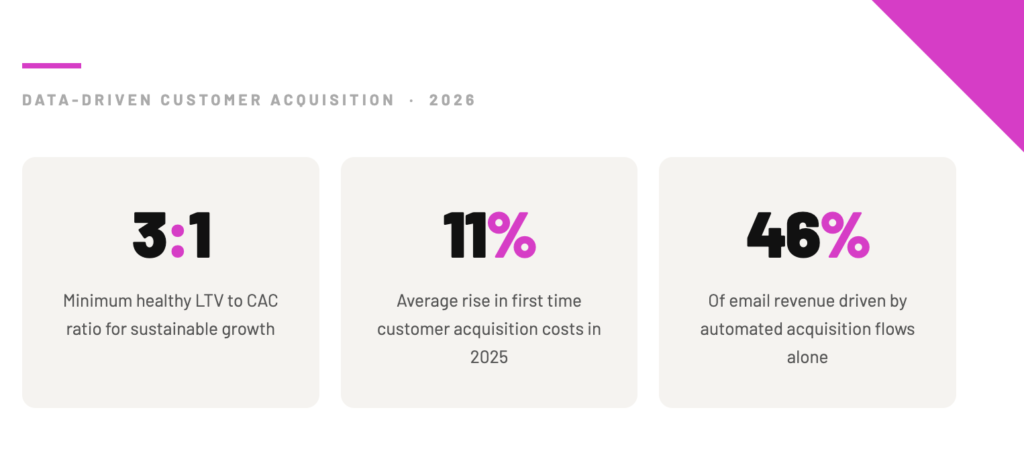
The first and most common mistake marketing leaders make is defining their target audience demographically. Age, job title, and sector are proxy signals at best. What you actually need to know is which of your existing customers have the highest lifetime value, the lowest churn rate, and the highest propensity to refer others.
Pull your customer data, segment it by revenue generated over 12 and 24 months, and identify the top quartile. Now ask: what do these customers share? Which acquisition channels did they enter through? What was their first purchase behaviour? What industries or company sizes cluster most heavily? This cohort is your acquisition benchmark, not your entire customer base.
Step 2. Build your data infrastructure before your campaigns
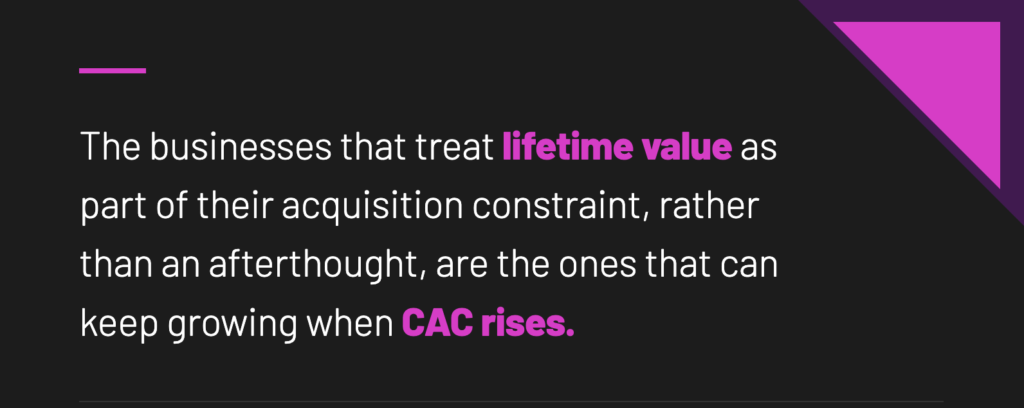
You cannot run a data-driven acquisition strategy on a CRM that is partially updated, attribution that does not track past the first click, and reporting that lives in disconnected spreadsheets. The infrastructure has to come first.
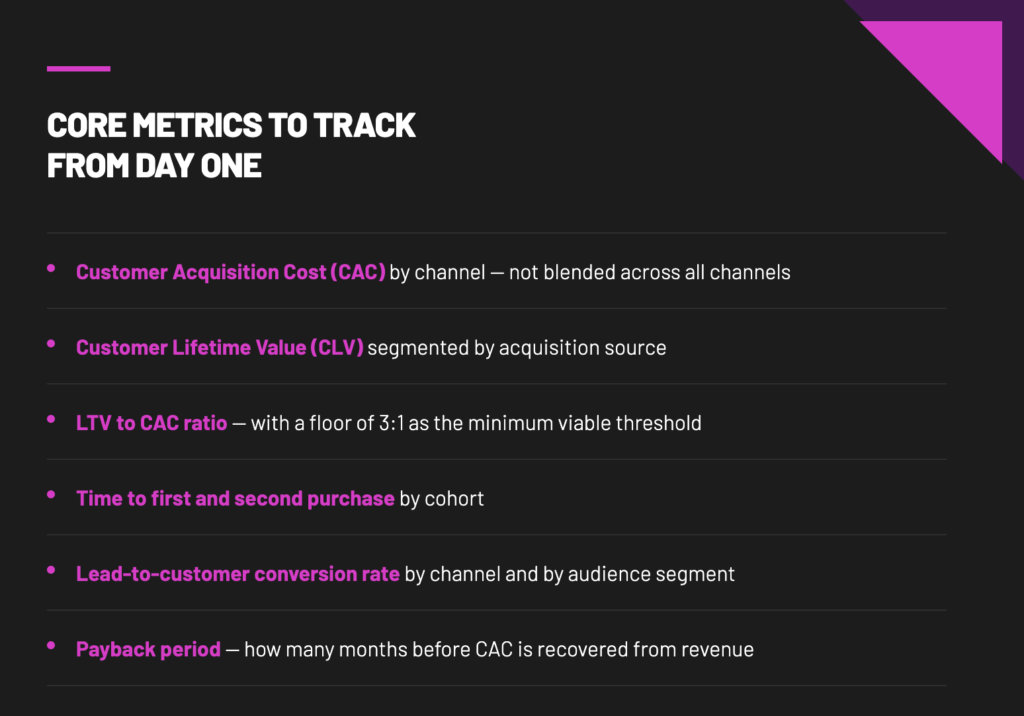
At minimum, your stack needs: a CRM that captures lead source with precision, UTM parameters consistently applied across every paid and organic touchpoint, conversion tracking configured correctly in your ad platforms, and a reporting cadence that shows channel-level CAC and return on ad spend in one view. This is not sophisticated technology. It is the disciplined implementation of tools most teams already have.
Step 3. Select channels based on evidence, not assumptions
Once you know who your best customers are and where they came from historically, channel selection becomes an analytical exercise rather than a strategic debate. You are not asking which channels you believe in. You are asking which channels have demonstrably produced customers with a CLV that justifies the CAC.
For most B2B organisations, content marketing combined with search engine optimisation consistently delivers the strongest long-term return, building authority and generating qualified inbound leads at a lower marginal cost than paid advertising over time. Paid channels are not wrong, but they should be used to accelerate a proven offer, not to discover one. Start with the channels where your highest-value customers entered, then stress-test them with a controlled budget before scaling.
Step 4. Deploy behavioural triggers, not broadcast campaigns
Generic, scheduled outreach to an undifferentiated list is not acquisition strategy. It is noise. The shift that high-performing marketing teams have made is from broadcast thinking to trigger-based thinking: delivering personalised, relevant communication at the precise moment a prospect signals intent.
When a prospect visits your pricing page three times in a week, that is a signal. When a lead downloads a specific piece of content, that tells you something about where they are in their decision process. When a free-trial user completes a key action, that predicts conversion likelihood. Each of these moments is an opportunity to intervene with the right message, not to add the person to a generic nurture sequence.
Step 5. Use predictive analytics to prioritise spend
The most significant shift available to marketing directors right now is moving from reactive analysis to predictive scoring. Rather than reviewing last month’s conversion data and adjusting next month’s budget accordingly, predictive models allow you to score prospects in real time based on behavioural signals, then allocate spend and sales effort toward those with the highest predicted lifetime value.
This is not exclusively the domain of enterprise organisations with data science teams. The AI-powered lead scoring tools embedded in most modern CRM and marketing automation platforms are now accessible to mid-market businesses. The competitive advantage comes not from having the tool, but from integrating its outputs into your actual resource allocation decisions.
Step 6. Treat acquisition and retention as one connected system
A common structural mistake is separating the acquisition team from the retention team, as though they are operating on different parts of the business. They are not. Your retention data is the most precise acquisition intelligence you have. The customers who stay longest, spend most, and refer others are telling you exactly which acquisition profiles to replicate and which to stop chasing.
Run cohort analysis by acquisition date and acquisition channel. Group customers by when they were acquired and track their revenue trajectory over 12, 18, and 24 months. The patterns that emerge will reorder your channel priorities faster than any external benchmark can.
The compounding advantage of building it right
A data-driven acquisition strategy is not a project with a completion date. It is a system that improves with every campaign cycle because each cycle generates new data, and that data sharpens the model. The marketing teams that invest in getting the foundation right in year one find that by year two, their CAC is declining even as their reach is expanding, because they are targeting more precisely and wasting less budget on audiences that were never going to convert.
The teams that skip the foundation and go straight to campaigns are permanently optimising noise. They will always be busy, and they will rarely be compounding.
Building a data-driven acquisition strategy from scratch requires discipline before it requires creativity. Define your best customers first. Build your measurement infrastructure before your campaigns. Select channels with evidence. Deploy triggers rather than broadcasts. Score and prioritise with predictive tools. And close the loop between acquisition and retention data so the system learns.
That is the framework. The organisations that apply it consistently are the ones that stop guessing and start building marketing that compounds.