

Stop treating paid search and paid social as rivals. They solve different problems. The question isn’t which one is better; it’s knowing which one you need right now, and how much of each.
Here’s the short version. Paid search captures demand that already exists. Paid social creates demand that doesn’t yet exist. If people are actively searching for what you sell, start with search. If they’re not, because your product is new, your category is niche, or your audience doesn’t know they have the problem you solve, you need social first.
Most businesses need both eventually. But getting the balance wrong, or running both without a clear purpose for each, is one of the fastest ways to burn through a paid media budget with nothing to show for it.

What each channel actually does
Paid search: Google and Bing Ads put you in front of people at the exact moment they’re looking for a solution. The intent is there. The hand is already raised. You’re not interrupting anyone; you’re answering a question they just asked. That’s why search tends to convert well and why cost-per-acquisition figures are usually easier to defend.
Paid social: Meta, LinkedIn, TikTok, Reddit, works differently. You’re reaching people who aren’t searching for you right now. You’re interrupting their scroll. That’s not a weakness; it’s a feature if you use it right. Social is where you build awareness, shape how people think about a problem, and put your brand in front of an audience before they ever type anything into Google. When it works, it fills the top of your funnel and makes your search campaigns more efficient.
The honest comparison
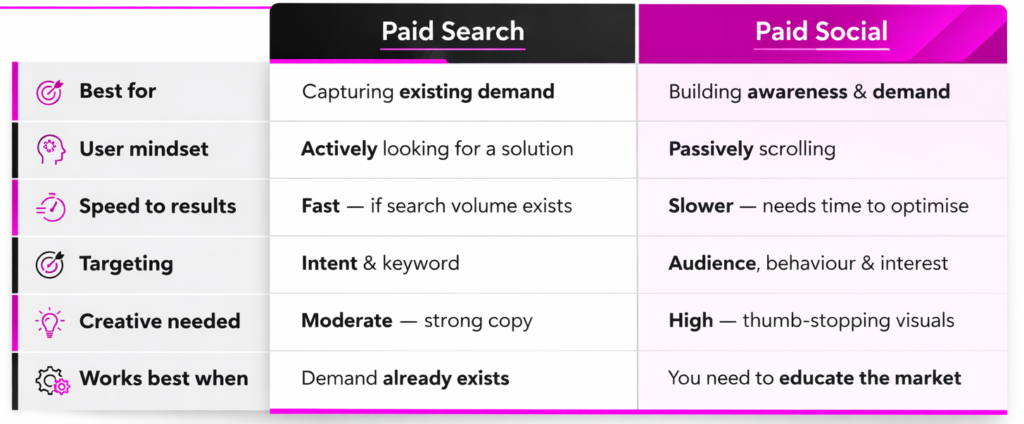
How to decide what you need
Answer two questions honestly.
First: are people already searching for what you sell? Go to Google Keyword Planner and look up the most obvious terms for your product or service. If there’s meaningful search volume, paid search should probably be your starting point. The demand is there; you just need to show up for it.
Second: do those same people know they have the problem you solve? If the answer is no, if your product is new, disruptive, or solves a pain point your audience hasn’t labelled yet, social comes first. You need to create awareness before the search can do its job.
For most B2B businesses, the right move is search-led with social support. Run a search to catch the people actively looking, and use LinkedIn or Meta to warm up the broader audience who aren’t there yet. For consumer brands launching something new, flip it: social to build awareness first, then search to mop up the demand you’ve created.
Where most businesses go wrong
They split the budget equally between the two channels and call it a strategy. It isn’t. Equal split just means neither channel gets enough investment to perform properly, and when results are underwhelming, it’s impossible to tell which channel is failing or why.
The other mistake is running both channels in isolation. Your search and social campaigns should be talking to each other. If someone saw your LinkedIn ad last week and is now searching for you on Google, your search campaign should be bidding on your brand terms to close that loop. If certain search queries are converting particularly well, those same messages should be informing your social creative. Joined-up thinking here can make both channels meaningfully more efficient.
A rough starting point on budget
If you’re early-stage or working with a limited budget, go all-in on one channel first. Spreading £2,000 a month across search and social gives you £1,000 each, which is often not enough to get meaningful data on either. Pick the one that matches your demand situation, learn what works, then expand.
Once you have the budget to run both properly, a reasonable starting ratio for most B2B businesses is 60/40 in favour of search, enough on social to build a pipeline of future demand, and more on search to capture the near-term wins. Test, adjust, and let your cost-per-customer data do the talking from there.
Not sure where to put your paid media budget?
We help marketing teams build paid channel strategies that are based on data, not guesswork with a clear view of what each channel is generating and where to invest next. Let’s talk.